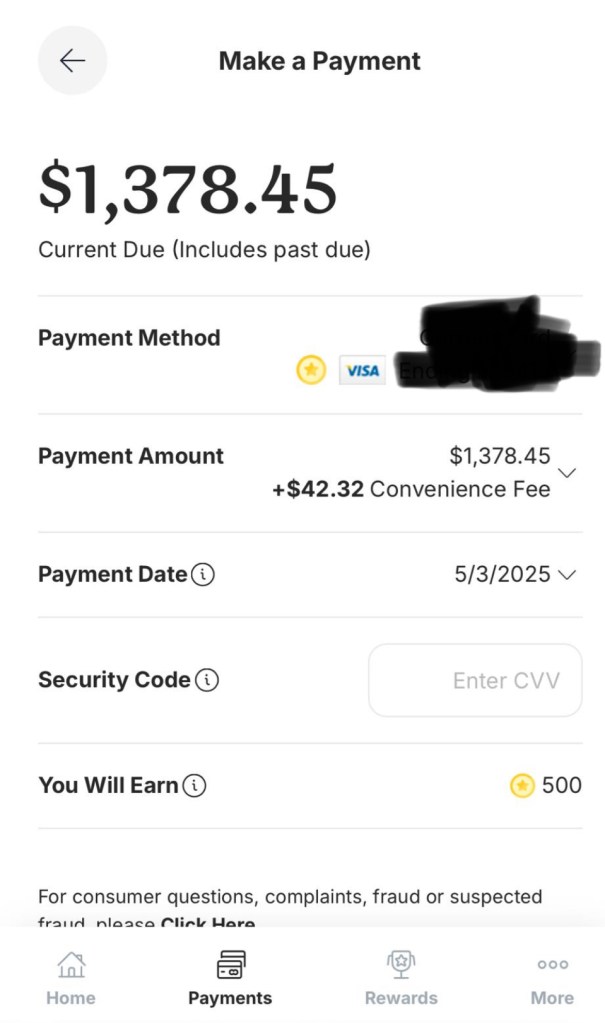
Last year, I went online to pay my rent. Like most people, I was simply going to use my debit card and move on with my day. That was until I noticed a $42.32 convenience fee!
That’s roughly 3.2% of my rent, just for the privilege of using my own debit card to pay a bill I already owed.
I thought that was absolutely insane!
Instead, I chose to pay directly from my checking account using an ACH transaction. The fee? Just $1.95.
Same rent. Same payment. Same money. But a difference of $40.37, simply because of how I chose to pay.
That got me thinking.
When did convenience become so expensive?
Every time we swipe, insert, or tap a credit or debit card, there’s a financial system working behind the scenes. Merchants pay processing fees, often around 1% to 3% or more depending on the card and transaction. And while those fees may seem small individually, imagine how much they add up to across millions of transactions every single day.
And that’s just the merchant side!
Credit card issuers also generate billions through interest charges, annual fees, late fees, and other sources of revenue.
Suddenly, it made a lot more sense to me why some small businesses and mom-and-pop shops encourage cash payments or have minimum purchase requirements for credit cards.
Those little transaction fees add up, especially when you’re operating a small business with tight profit margins.
But here’s where things get really interesting.
Nearly 2 out of 3 working-age Americans (63.2%) used credit cards to purchase groceries, according to 2025 survey data.
Think about that.
We’re no longer just using credit cards for vacations, expensive purchases, or emergencies. We’re using them to put food on our tables.
Back in the 1920s, department stores and other businesses began offering charge accounts and cards to their customers. By 1958, revolving bank credit cards were beginning to reshape how Americans borrowed and spent money.
What was once a relatively limited payment privilege has become an everyday part of American life.
Today, we barely think twice about pulling out a piece of plastic or tapping our phones to pay for something.
But have we ever stopped to think about who is really benefiting from all this convenience?
Between merchant processing fees, interest payments, and other charges, the payment and lending industries generate enormous amounts of revenue from the way we spend and borrow money.
And here’s the part that bothers me most.
We’ve become so accustomed to paying for convenience that we rarely question the cost anymore.
Are we controlling our money, or have we allowed the financial system to control how we use it?
That $42.32 convenience fee opened my eyes to something much bigger than paying rent.
It reminded me that financial education isn’t just about how much money we make.
It’s about understanding how money works, who profits from our financial decisions, and how we can make smarter choices with the money we’ve worked so hard to earn.
The next time you reach for that plastic card, ask yourself one simple question:
Is this really convenient for me, or is it more profitable for someone else?


Leave a Reply